
Smart Green City: Energy planning in a District
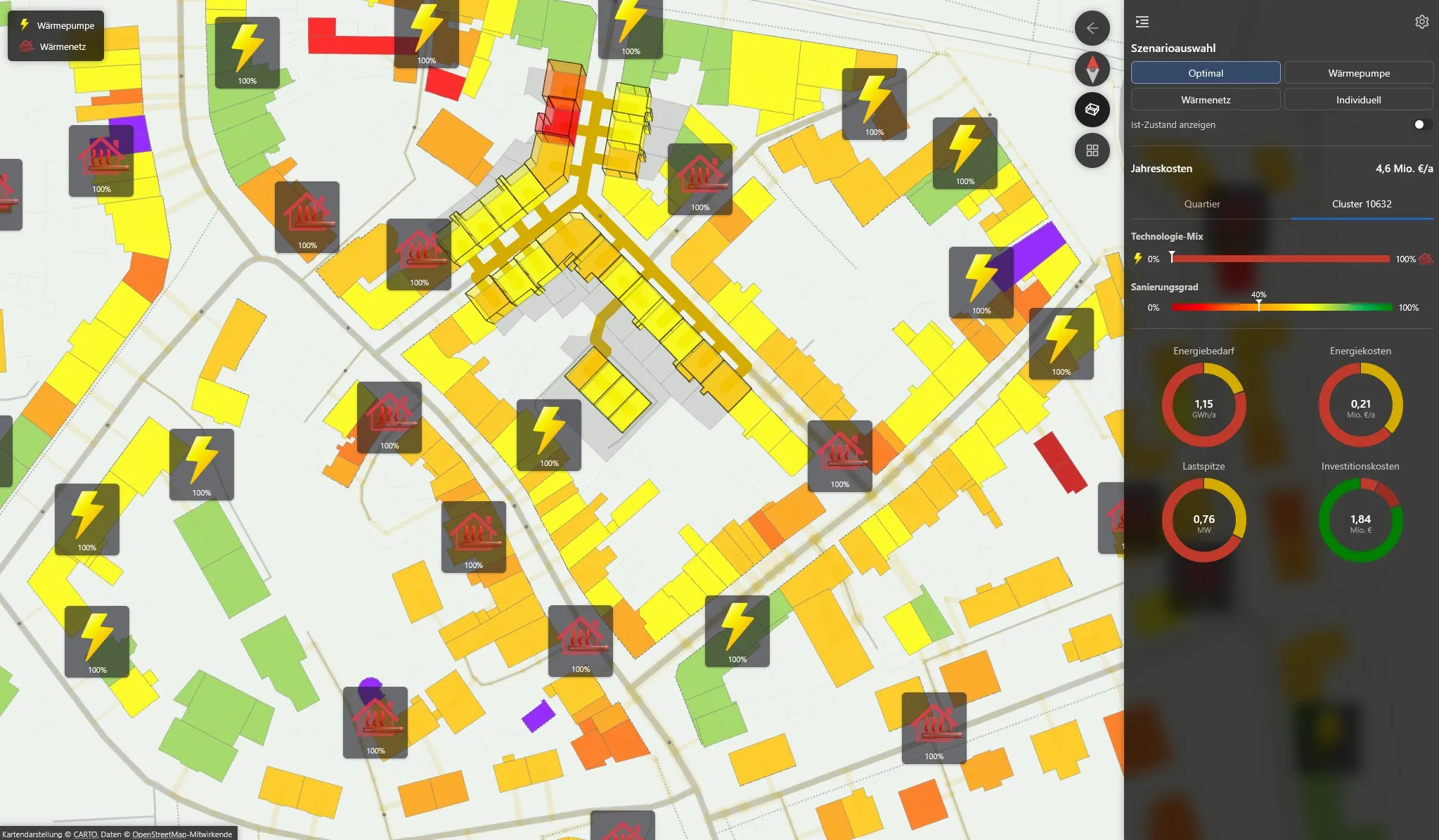
This project focuses on the energy supply of urban districts. The goal is to develop a simulation tool that calculates mathematically optimal energy supply scenarios for a district and visualizes them clearly. Using a digital, interactive network map, users can easily “play through” different grid planning scenarios. Their impact on overall societal costs becomes immediately visible. A key component is the retrofit calculator. Based on municipal building data, it determines the current and future energy demand of individual buildings and shows how different retrofit measures based on DIN standards affect both energy demand and investment costs. The tool is being validated together with Stadtwerke Konstanz using real measurement data from the pilot district Stadelhofen in Konstanz.
Goals and Approach
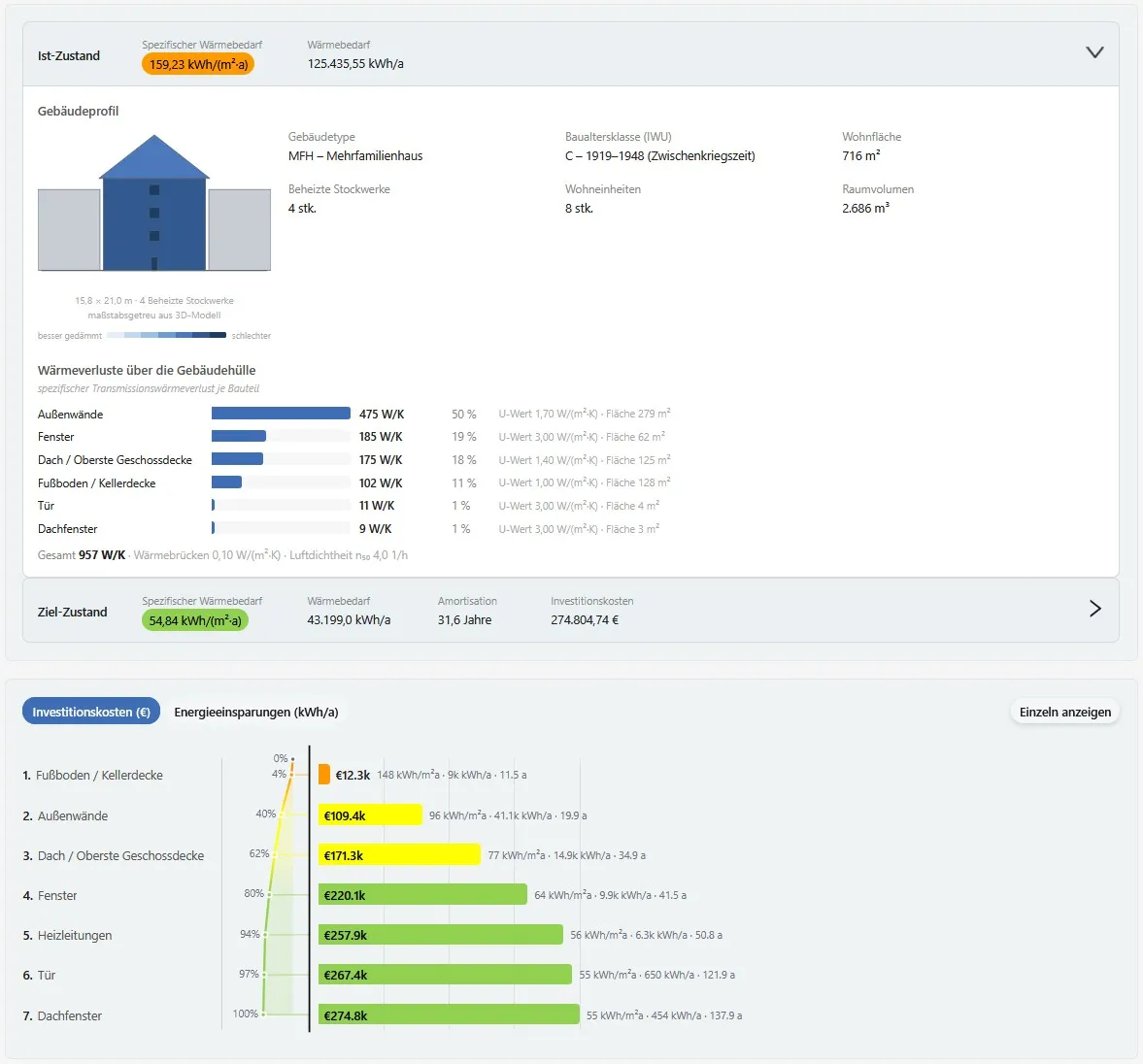
The project team’s main goal is to create a sound basis for decarbonization strategies at the district level. To achieve this, the simulation tool links energy grid planning with the development of the building stock. The retrofit calculator estimates the current energy condition of the buildings and shows how their energy demand changes through retrofitting. These results feed directly into the calculation of the optimal energy supply. This shows how private and public funds can be used as efficiently as possible. The tool will be provided as a cloud-based application on a website, making it easily accessible to citizens and policymakers alike.
Innovations and Perspectives
Existing planning tools usually treat building retrofits and energy supply separately, producing separate scenarios for each. This project brings both levels together in a single integrated model for the first time. As a result, interactions, such as those between retrofit rates and grid expansion, become directly visible and can be evaluated. Validation with real measurement data ensures that the results hold up in practice. In the future, the tool can be transferred to other districts with different spatial structures. It can thus help municipalities, utilities and the public make the local energy and heat transition transparent and cost-efficient.
Project Partners
Funding
Federal Ministry of Housing, Urban Development and Building
This research is supported by the City of Konstanz’ Smart Green City program as part of the "Model Projects Smart Cities" funding program of the German Federal Ministry for Housing, Urban Development and Building (BMWSB) under grant no. KfW 13622889.